7 Sales Tax Mistakes Small Businesses Make (and How to Fix Them)
Sales tax errors are among the most costly mistakes small businesses make. The most common ones, and how to avoid or correct each.
A three-person graphic design shop in Oakland got an audit letter from the California Department of Tax and Fee Administration last spring. The state had reconstructed three years of sales from the shop's own shipping manifests, matched them against what the shop had remitted, and assessed just over $18,000 in uncollected tax plus penalties and interest. The owner had assumed her work was services. Some of it was. The custom printed merchandise she'd shipped on behalf of client campaigns wasn't, and nobody had flagged it.
That kind of notice is rarely a surprise from the inside. Sales tax errors tend to pile up slowly: a miscalculated receipt here, a missed filing there, a product category that drifted into taxable territory without anyone updating the billing system. By the time a state catches up, the amount owed is usually less painful than the penalties wrapped around it. The mistakes below are the ones bookkeepers and accountants see most often across small business clients.
Getting the Math Wrong
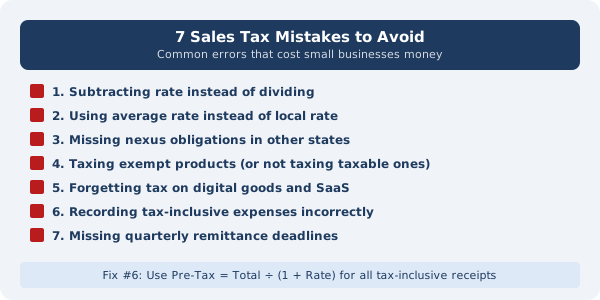
The single most common arithmetic mistake is subtracting the tax rate instead of dividing it out. A client pays $108.00 at an 8% rate. You need the pre-tax figure for the books. The instinct is to knock 8% off the top: $108 minus $8.64 equals $99.36. The correct answer is $100.00, recovered by dividing the total by 1.08.
On a single coffee receipt, the gap is pocket change. On a $10,800 invoice at 8%, the pre-tax figure is $10,000.00, not $9,936.00. Run that $64 error across a year of client invoices and you have a material restatement of revenue and expenses. The fix is the formula: Pre-Tax = Total ÷ (1 + Rate ÷ 100). Our reverse tax calculator does it in one step, and our walkthrough of the backwards calculation explains why subtraction breaks down.
The other math trap is the statewide average rate. Rate aggregators like the Tax Foundation publish combined averages that are fine for back-of-envelope work and useless for collection. If your storefront sits in Seattle, the rate is 10.25%, not the Washington statewide average of 9.38%. Collect at the average and you're short 0.87% on every ticket, a gap you'll eat out of margin when the return comes due. Every state revenue department runs an address-based rate lookup. Use that, and put a quarterly reminder on the calendar to check whether anything changed.
Missing Where You Owe
Nexus is where most online sellers get caught. Before the 2018 South Dakota v. Wayfair decision, a business generally had to collect sales tax only in states where it had a physical presence: an office, a warehouse, or an employee. After Wayfair, every state can require collection based on economic nexus, usually pegged at $100,000 in sales or 200 transactions a year into that state. The specific triggers vary, and they've shifted several times since 2018. Our sales tax on online purchases guide walks through the thresholds in more detail.
The practical problem for a small e-commerce operation shipping to thirty states is that nexus can appear mid-year, often without any change on your end beyond a good month. Sales volume spikes, a threshold gets crossed, and you now owe that state registration, collection, and filing for every sale going forward (and sometimes retroactively). The shops that get surprised by this are usually the ones tracking orders by channel but not by destination state. A basic pivot of your order data by ship-to state, reviewed monthly, catches the issue before it becomes a penalty. Avalara, TaxJar, and similar services automate the tracking and registration if your volume justifies the cost.
Physical nexus still matters too. Remote employees, a contractor working regularly out of another state, inventory stored in an Amazon FBA warehouse, or a trade show booth can each trigger nexus in states you've never visited.
Misclassifying What's Taxable
Not everything you sell is taxable, and not everything you think is exempt actually is. Most states exempt unprepared groceries, prescription drugs, and medical equipment. Some exempt clothing below a price cap (New York's under-$110 rule is the usual example). Texas exempts residential electricity. States run sales tax holidays on back-to-school items and, in some jurisdictions, hurricane preparedness supplies. Charging tax on an exempt item creates a refund problem; missing tax on a taxable item creates a liability problem.
Digital products are where this goes sideways fastest. More than thirty states now tax some flavor of digital goods: downloaded software, streaming subscriptions, e-books, online courses, SaaS. The rules are inconsistent. Some states tax all digital products, some only specific categories, some draw a line between "digital goods" and "electronically delivered services" that matters a lot on a tax return and not at all to the customer. A SaaS company telling itself that software isn't taxable because its home state doesn't tax it may be wrong in twenty other states where it has nexus.
The fix is a taxability matrix keyed to your actual product catalog. Every state DOR publishes taxability guides by category, and the Sales Tax Institute maintains cross-state charts for digital products specifically. If you haven't reviewed your SKUs against the states where you collect, that review is overdue.
The bookkeeping mirror of this problem is recording tax-inclusive expenses at the wrong amount. Pay £1,200 for a UK software license with 20% VAT baked in, and the correct entries are a £1,000 software expense plus £200 in input VAT, not a flat £1,200 expense. Booking the full gross amount overstates costs and, if you're VAT-registered, quietly strips away a reclaim you were entitled to. For any tax-inclusive invoice, split the net and the tax with the reverse formula and post them to separate accounts. Our inclusive vs. exclusive tax pricing guide has worked examples.
Collecting but Not Remitting on Time
Sales tax you collect from a customer isn't your revenue. It's a trust fund liability: money you're holding on behalf of the state, which expects it back on a schedule (usually monthly or quarterly, based on your volume). Miss a filing and most states apply penalties of 5% to 10% of the balance per month, plus interest, on top of the tax itself. In many states, unpaid trust fund tax is one of the few business liabilities that pierces the corporate veil and can be assessed personally against an owner or officer.
The failure mode is almost always cash flow. Collected tax sits in the operating account, gets spent on payroll or inventory, and has to be scrambled together at filing time. A business that does this for two quarters in a row and then hits a slow month is how a "temporary" borrow turns into $15,000 owed. The countermeasure is boring and works: move collected tax into a separate bank account, or at minimum a segregated ledger account, on a weekly cadence. Put filing deadlines on a shared calendar with reminders a week out, not the morning of. If you file in multiple states, a compliance service is almost certainly cheaper than the first penalty it prevents.
When to Get Help
None of the above requires a CPA on retainer. What it requires is a clear view of where you have nexus, what you sell in each of those states, and a clean separation between tax collected and tax remitted. A bookkeeper familiar with multi-state sales tax can get that view built in a couple of engagements. A compliance platform can maintain it.
If you're already behind (missed filings, uncollected tax on past sales, a notice sitting in the mail), most states run voluntary disclosure programs that waive penalties and shorten the lookback period in exchange for coming forward first. Those programs work. They do not work after the audit letter arrives.
For the wider context on how the US sales tax system fits together, see our plain-English guide to how sales tax works.