Tax-Inclusive vs Tax-Exclusive: What's the Difference?
Tax-inclusive means tax is already in the price. Tax-exclusive means tax is added at checkout. Learn how each works and when reverse calculation matters.
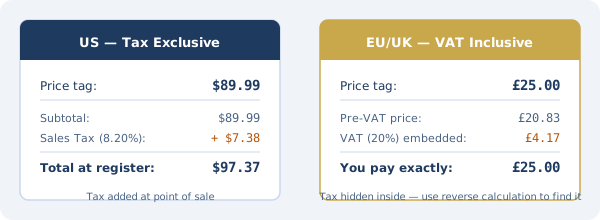
In Germany, a €10 price tag costs €10 at the till. In California, a $10 price tag costs $10.87. Same sticker, different math at checkout. That one difference shapes how you record the transaction, how you reclaim tax on business expenses, and whether you need a reverse calculation at all.
Tax-Exclusive Pricing: The US Standard
In the United States, prices are displayed before tax. The sticker price, the menu price, the e-commerce listing: none of them include sales tax. Tax gets added at the point of sale.
What this looks like on a receipt:
```
Subtotal: $89.99
Sales Tax: $7.38 (8.20%)
Total: $97.37
```
The price you agreed to was $89.99. The $7.38 is added on top. To find out how much tax was applied, you read the receipt: it's printed separately.
When does this require reverse calculation? If you only know the final total ($97.37) and the rate (8.20%), not the subtotal. That happens when processing receipts without the breakdown, working from summary data, or handling a total-only receipt that doesn't itemize the tax.
Tax-Inclusive Pricing: The International Standard
In the European Union, United Kingdom, Australia, Canada (most provinces for certain goods), and most of Asia, prices include tax. What you see is what you pay.
A £25 book in a UK bookshop costs £25. There's 20% VAT embedded inside that price. The breakdown is:
```
Pre-tax price: £20.83
VAT (20%): £4.17
Listed price: £25.00
```
To find the VAT amount or the pre-tax price, you divide. The guide to calculating sales tax backwards walks through the full division formula and why subtraction gives the wrong answer, but the short version here is: £25.00 ÷ 1.20 = £20.83 pre-tax, with £4.17 in VAT. Reverse tax calculation is unavoidable for anyone doing accounting in VAT-inclusive jurisdictions.
The Formula for Each Direction
Reverse (tax-inclusive to pre-tax):
> Pre-Tax = Total ÷ (1 + Tax Rate ÷ 100)
Forward (pre-tax to tax-inclusive total):
> Total = Pre-Tax × (1 + Tax Rate ÷ 100)
Both directions live in our reverse tax calculator. Select "Tax is included in the total" for the reverse direction, and "Tax is NOT included" for the forward direction.
Common VAT Rates Around the World
| Country | Standard VAT Rate | Calculator Divisor |
|---|---|---|
| United Kingdom | 20% | 1.20 |
| Germany | 19% | 1.19 |
| France | 20% | 1.20 |
| Netherlands | 21% | 1.21 |
| Australia (GST) | 10% | 1.10 |
| Canada (GST) | 5% | 1.05 |
| India (GST) | 18% | 1.18 |
| Japan (Consumption Tax) | 10% | 1.10 |
These are standard rates; reduced rates apply to certain goods in many countries (food, medicine, and children's items are often taxed at 0% or a lower rate).
Japan's consumption tax is tax-inclusive at 10%, with a reduced 8% rate on takeout food, newspapers, and a handful of other categories. Australia's GST is also tax-inclusive, fixed at 10%, and businesses are required to display GST-inclusive prices in any advertising or listing aimed at consumers. The EU's VAT system is tax-inclusive everywhere for retail prices, but the invoice requirements differ country by country. Germany and France generally require a separate VAT line showing the net amount, VAT rate, and VAT amount. Some smaller member states accept simpler inclusive-only receipts below a specified threshold. If you're claiming input VAT on a business return, an invoice that only shows the inclusive total without a VAT breakdown may not qualify in certain jurisdictions, which is a common trip-up for US companies operating in Europe for the first time.
Why This Matters for Bookkeeping
If your business receives invoices with VAT included, you can't just enter the invoice total as an expense. The VAT component may be recoverable (if you're VAT-registered) and needs to be separated out for your tax return.
An example: you receive a supplier invoice for £600 inclusive of 20% VAT.
- Pre-tax (net) amount: £600 ÷ 1.20 = £500
- VAT: £100
You record £500 as the expense and £100 as reclaimable input VAT, not £600 as the total expense. Skip the separation and you overstate your expenses by £100 and claim the wrong VAT amount. Multiply this across hundreds of invoices and the discrepancy becomes material.
Subscription Services: A Tricky Middle Ground
Many online subscriptions and SaaS platforms list prices exclusive of VAT/GST in their marketing but charge the inclusive amount at checkout. You sign up for a £19/month plan and your card is charged £22.80 (with 20% UK VAT).
If you're expensing these for a business, the subscription cost is £19 and £3.80 is VAT. Our back-calculate tax from total tool handles this directly: enter £22.80, set the rate to 20%, and you get the split instantly.
How to Tell Which Type You're Dealing With
Clues it's tax-inclusive:
- You're outside the US (UK, EU, Australia, Japan, etc.)
- The receipt doesn't show a separate tax line
- The price tag matches what you paid exactly
- The invoice says "VAT included" or "inc. GST"
Clues it's tax-exclusive:
- You're in the US
- The receipt shows "Subtotal" and "Tax" as separate lines
- The register total is higher than the sticker price
- The invoice says "plus applicable taxes" or "excl. VAT"
For US receipts, you're almost always dealing with tax-exclusive pricing. The subtotal and tax are shown separately, so reverse calculation is only needed when you only have the total. For international invoices, tax-inclusive pricing is the default, and you'll reverse-calculate frequently.
Practical Application: Which Calculator Mode to Use
In our sales tax reverse calculator:
- "Tax is included in the total": Use for receipts where the displayed price includes tax. Enter the total you paid, get the pre-tax price out. Works for US tax-inclusive scenarios, UK VAT, EU VAT, Australian GST, and Japanese consumption tax.
- "Tax is NOT included": Use when you have the pre-tax price and want to see what tax will be added. Enter the pre-tax price, get the total you'll pay.
See our reverse tax calculation examples for worked examples across both modes and multiple countries.