Do You Pay Sales Tax on Online Purchases? State Rules
Since the 2018 Wayfair ruling, most online purchases include sales tax. Learn which states collect it, how marketplace facilitator laws work, and what you owe.
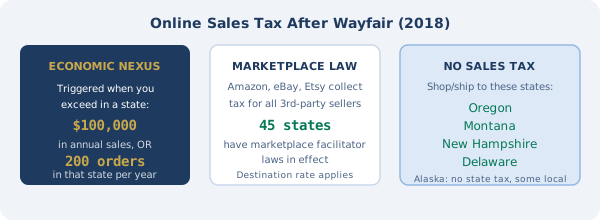
If you've noticed that Amazon now charges sales tax in your state when it didn't a few years back, there's a specific Supreme Court decision to thank. On June 21, 2018, the Court ruled in South Dakota v. Wayfair, Inc. that states can require out-of-state sellers to collect sales tax without any physical presence in the state. That ruling rewired how e-commerce works for buyers and sellers alike.
Before Wayfair, states could only force sellers with a physical footprint (a warehouse, an office, employees) to collect tax. After Wayfair, pure economic activity in a state is enough.
How Online Sales Tax Works Now
Every US state with a sales tax (45 states plus DC) can now require out-of-state online sellers to collect tax if those sellers meet the state's economic nexus threshold. The standard threshold in most states is:
- $100,000 in sales to customers in that state per calendar year, OR
- 200 separate transactions to customers in that state per calendar year
Cross either threshold, and the seller must register in that state, collect the applicable sales tax on your purchases, and remit it to the state.
As a practical matter, this is why the major national retailers now charge tax pretty much everywhere. Amazon, Walmart, Target, Best Buy, Chewy, and Wayfair all blow past those thresholds in every state within days of the year starting, so they register and collect from day one. If you bought something online in 2017 and it was tax-free, the same purchase in 2026 almost certainly isn't.
Marketplace Facilitator Laws
Many states went a step further. They require marketplace facilitators (Amazon, eBay, Etsy, Walmart Marketplace) to collect and remit tax on behalf of third-party sellers on their platforms, even if those individual sellers wouldn't have met nexus thresholds on their own.
This simplifies compliance dramatically. A small seller with $40,000 in Amazon sales nationwide doesn't need to file returns in 45 states. Amazon handles the collection and remittance on their behalf.
Currently, all 45 states with sales tax have marketplace facilitator laws. If you buy from a third-party seller on Amazon, eBay, or Etsy, you're paying sales tax on that transaction, even if the seller is a one-person operation working from a kitchen table.
Which States Still Don't Collect Online Sales Tax?
Five states have no general sales tax and therefore no collection requirement:
- Oregon
- Montana
- New Hampshire
- Delaware
- Alaska (no statewide sales tax, though some localities do)
Buy from a retailer with no nexus in other states, ship to one of these states, and you'll pay no sales tax. For expensive purchases, some people specifically ship to Oregon (which has no sales tax at any level) if they have an address there.
What Rate Gets Applied to Your Online Order?
The rate applied to your online purchase is your destination rate: the combined state and local sales tax rate where the package is being shipped.
This was a change from before Wayfair, when origin-based collection was more common. Now, sellers must use the buyer's location rate. For a seller in a state with origin-based sourcing (Arizona, Illinois, Mississippi, Missouri, New Mexico, Ohio, Pennsylvania, Tennessee, Texas, Utah, Virginia), the rules differ slightly, but for most states destination sourcing applies.
So your online order from any major retailer should show roughly the same tax rate as a physical store in the same city.
Digital Goods and Online Services
Physical goods shipped to your door are relatively straightforward. Digital products are messier.
Streaming services (Netflix, Spotify, Disney+): Taxable in about 35 states. Not taxable in others. The applicable tax shows up in your subscription cost.
Downloadable software: Taxable in most states that tax digital goods. SaaS (Software as a Service) is taxable in most states now, though the rules are still evolving.
E-books and digital media: Taxable in some states, exempt in others. New York doesn't tax them; Texas does.
Online courses and educational content: Often exempt if the course qualifies as an educational service, but rules vary significantly.
If your streaming bill went up recently and the subscription price didn't change, a new state law taxing digital services is usually the culprit rather than the provider raising rates.
If You Didn't Pay Sales Tax: Use Tax
When you make an online purchase and the seller doesn't collect sales tax (because they didn't meet your state's nexus threshold), you likely still owe that tax to your state. It's called use tax, and it applies to taxable goods used, stored, or consumed in your state. Many state income tax returns have a line for it.
In practice, individual consumers rarely report small use tax amounts, and states don't typically audit personal returns looking for a $12 use tax liability on a hobby purchase. Businesses are a different story. Companies are expected to track and remit use tax on their purchases, and sales tax auditors go looking for it during field audits, especially on equipment and office supplies bought from out-of-state vendors.
How to Calculate How Much Tax Should Have Been Applied
If you received an online order and want to verify the tax charged, or you're working backwards from a tax-inclusive total, the formula is:
Tax Amount = Total − (Total ÷ (1 + Rate ÷ 100))
Or use the reverse tax calculator. Enter the order total and your local combined tax rate to see the pre-tax price and the exact tax amount. This is useful for expense reporting on online purchases.
For your local combined rate, the IRS Sales Tax Deduction Calculator (irs.gov) lets you look up by ZIP code.
For Small Business Sellers: What You Need to Do
If you sell online and ship to customers in other states, you may have significant compliance obligations:
1. Track your sales by state. Once you approach a state's threshold, you need to know.
2. Register before you cross thresholds. Registration is required before collection, not after.
3. Use the correct destination rate, not your home state's rate.
4. File returns on time, including $0 returns when required.
See our 7 sales tax mistakes small businesses make for a more detailed breakdown of what to watch for.
For individual transactions where you need to reconcile what was charged, our pre-tax price calculator handles it instantly.