Sales Tax for Freelancers: What You Actually Need to Know
Most freelancers don't charge sales tax, but some must. Learn which services are taxable, when you have nexus, and how to handle tax-inclusive client payments.
A web designer in Austin spent two years billing clients for site builds without thinking twice about sales tax. Then one project grew: she added a line for a limited run of custom branded notebooks, shipped direct to the client's customers in California, New York, and Illinois. Three months later she got a letter from the Texas Comptroller asking about her data processing services, and a follow-up from California about the physical goods. Neither question had a quick answer.
That is the usual shape of freelance sales tax trouble. The default rule, services are generally not subject to sales tax in most US states, is correct often enough that freelancers assume it is always correct. It isn't. The exceptions have enough bite to matter, and the line between service and product gets blurry the moment you sell anything tangible or digital alongside your time.
Are Freelance Services Taxable?
The default answer is no, services are not subject to sales tax. The US sales tax system was originally built around tangible personal property, meaning physical goods you can touch. Services were largely excluded.
But states, always looking for revenue, have gradually expanded sales tax to cover specific service categories. The states that tax the widest range of services include Hawaii, New Mexico, South Dakota, and West Virginia. Other states tax specific categories: Texas taxes some services, Florida taxes commercial rentals, and so on.
Services most commonly taxable in some states:
- Software as a Service (SaaS): If you're a developer selling a software subscription rather than hourly work, this is increasingly taxable in many states.
- Digital products: Stock photos, digital templates, custom code delivered as a digital download.
- Information services: Data feeds, research reports, database access.
- Advertising services: Some states tax certain advertising and marketing services.
- Repair services: Labor to repair tangible personal property is taxable in some states.
- Cleaning and janitorial services: Taxable in certain states.
- Photography: Wedding photos and portrait sessions are taxable services in some states.
Services almost always NOT taxable:
- Consulting
- Legal services
- Accounting and bookkeeping
- Writing and editing (in most states)
- Design services (in most states)
- Coaching and training
- Health and medical services
The "Mixed" Problem: Services Plus Goods
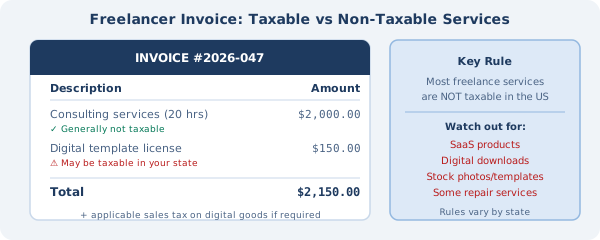
Where freelancers get into trouble is when a project includes both services and goods. If you're a web designer who charges $5,000 for a website build plus $200 for a theme license, are both components taxable?
The answer depends on how your contract is structured and what state your client is in. Some states look at the primary purpose of the transaction. If it's primarily a service with incidental goods, the whole thing follows service rules. Other states require you to separate and tax the goods component.
Itemize your invoices. Separate service hours from any physical or digital goods you're delivering, on their own lines with their own totals. The tax analysis gets much cleaner for you, your client, and anyone who has to sort it out later in an audit.
When Do You Have Nexus as a Freelancer?
Even if your services are taxable, you only owe tax in states where you have nexus. For most solo freelancers that means your home state (physical nexus where you live and work), and any state where your sales cross the economic nexus threshold (commonly $100,000 in sales or 200 transactions a year, though the exact trigger varies). The sales tax on online purchases guide covers the Wayfair rules and state-by-state thresholds in detail.
Most individual freelancers serve clients in many states but don't approach $100,000 per state with any single state. If your gross annual income is under $100,000 total, economic nexus in other states is unlikely to apply. High-earning freelancers and multi-person freelance shops need a closer look, especially if you have contractors working from other states (their presence can create nexus for you).
When Your Client Pays Tax-Inclusive Amounts
Some clients, particularly large corporations, pay invoices including a tax component when they're required to self-assess or withhold. You might invoice $1,000 for services and receive payment documentation showing $1,080 (including an 8% withholding or tax component).
If you receive a tax-inclusive payment and need to figure out the service fee versus the tax portion, the reverse tax calculator gives you the split instantly:
- Total received: $1,080
- Tax rate: 8%
- Service fee: $1,080 ÷ 1.08 = $1,000
- Tax component: $80
This also comes up in international freelance work. Many countries require withholding tax on payments to foreign freelancers, and understanding the net versus gross matters for both your invoicing and your tax filing. For the mechanics of pulling a pre-tax figure out of any total, see how to calculate sales tax backwards.
Business Expenses and the Reverse Calculation
As a freelancer, your business expenses are deductible. But to record them correctly, you need the pre-tax amount, not the tax-inclusive total on the receipt.
Example: You buy a $249.99 microphone (total with 8.68% California tax: $271.71) for your podcast freelance work.
- Pre-tax cost: $271.71 ÷ 1.0868 = $249.99
- Tax paid: $21.72
The $249.99 is your deductible business expense. The $21.72 in sales tax is also deductible, but as a separate sales tax expense or included in the item cost depending on your accounting method.
Our back-calculate tax from total tool handles this for any receipt.
Resale Certificates
If you're a freelancer who purchases tangible goods to resell as part of your projects (a graphic designer who resells print products, for example), you may be eligible for a resale certificate. This lets you buy those goods without paying sales tax upfront. You then collect tax from your client when you sell the finished product.
Resale certificates are issued by your state. They're specific to your business and the goods you're reselling. Misusing them (buying personal goods tax-free under a resale certificate) is tax fraud.
Practical Steps for Freelancers
If your services are not taxable (most freelancers):
- No collection, no registration, no filing for services
- Do deduct business expenses correctly using the pre-tax amounts
- Track receipts and use the reverse formula to split tax from totals
If your services might be taxable:
1. Identify the states where you have clients and nexus
2. Check the taxability of your specific services in those states (your state's DOR website is the starting point)
3. If taxable: register in each state, collect the applicable rate from clients, and file returns
If you aren't sure, talk to an accountant who knows your state's sales tax rules before you make a call. The penalty for not collecting when required can be the tax owed plus interest and penalties, and the cleanup from charging tax you didn't owe (refunds, amended invoices, a client who now thinks you don't know what you're doing) isn't trivial either.
For the bigger picture on how sales tax works in the US, see our plain-English guide to US sales tax. For the bookkeeping side of recording tax-inclusive business expenses, see our common sales tax mistakes guide.