Sales Tax vs VAT: Key Differences Explained
Sales tax and VAT both tax consumption, but they work very differently. Learn how each is calculated, collected, and why the same reverse formula works for both.
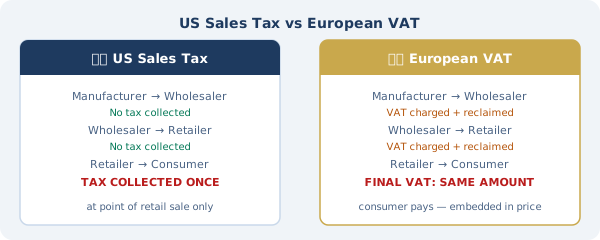
You're a US freelancer, and an invoice lands from a UK client with a line that says "VAT 20%" baked into the total. Or you're a small importer, and your customs broker keeps asking about VAT reclaims. Both sales tax and VAT (Value Added Tax) are consumption taxes the end consumer ends up paying, but the mechanics are different enough that assuming they work the same way leads to real accounting mistakes.
Here's how US sales tax and VAT actually diverge, and what that means when you see one or the other on an invoice.
The Fundamental Difference: When and How It's Collected
US Sales Tax:
Tax is collected once, at the point of retail sale. A manufacturer sells to a wholesaler with no tax charged. The wholesaler sells to a retailer, again no tax. The retailer sells to you, the end consumer, and tax is applied and collected at that single point.
VAT:
Tax is collected at every stage of the supply chain, but businesses can reclaim the tax they paid on their inputs. The consumer ultimately bears the full burden, just split into installments along the way.
Example with a 20% VAT rate:
- Manufacturer sells material to factory for £100 + £20 VAT = £120. Factory pays £120, government gets £20.
- Factory sells product to retailer for £200 + £40 VAT = £240. Retailer pays £240, but claims back the £20 it paid to the manufacturer, so the government nets £20.
- Retailer sells to consumer for £300 + £60 VAT = £360. Consumer pays £360. Retailer claims back the £40 paid to factory, so government nets £20.
- Total government VAT collected: £60. Total paid by consumer: £60.
The consumer pays the same final amount either way. The difference is that VAT is collected in pieces throughout the chain, which makes it much harder to evade than a single end-of-chain levy.
Display and Pricing
Sales Tax: Prices in the US are displayed before tax. A $50 shirt costs $50 on the tag and $54.13 at the register (at 8.25%). Tax is always visible as a separate line.
VAT: Prices in Europe, Australia, and most countries with VAT are displayed inclusive of tax. A €50 shirt costs €50. The VAT is embedded inside that price. You don't see it separately unless you specifically request a VAT receipt.
That's why reverse calculation comes up so often with VAT: the tax is baked in, so extracting the net price means dividing by (1 + rate). For a £360 item at 20% VAT, the pre-VAT price is £300 and the VAT is £60. If you need to do this regularly, the reverse tax calculator handles it directly, and the full derivation is in our backwards sales tax guide.
Tax Rates: Sales Tax vs VAT
US Sales Tax: 0% to 10.55%+ (combined state and local). Varies by state, county, city, and product type. No single national rate.
VAT rates by major country:
| Country | Standard Rate | Reduced Rate |
|---|---|---|
| UK | 20% | 5% (energy, some home improvements) |
| Germany | 19% | 7% (food, books) |
| France | 20% | 5.5% (food), 2.1% (medicine) |
| Italy | 22% | 10% (food services), 4% (basic foods) |
| Netherlands | 21% | 9% (food, water, books) |
| Australia (GST) | 10% | 0% (food, medicine, education) |
| Canada (GST) | 5% | Most provinces add PST or HST |
| India (GST) | 18% | Multiple tiers: 0%, 5%, 12%, 28% |
VAT rates are generally much higher than US sales tax rates because they fund more extensive public services in those countries.
Who Registers and Files
Sales Tax: Only businesses that meet nexus requirements in a state register and file there. A small US business selling only within its home state files one return with one state.
VAT: All businesses above the registration threshold must register and file VAT returns. In the UK, the threshold is £90,000 in taxable turnover per year (2024). In Germany, €22,000. Below these thresholds, small businesses are often exempt.
VAT-registered businesses must charge VAT on all taxable sales and can reclaim VAT on business purchases. That creates a self-policing system: every business in the chain has a financial incentive to make sure the previous link charged and documented VAT correctly, since their own reclaim depends on it.
Implications for US Businesses Selling to EU Customers
If you're a US-based business selling digital products or services to EU consumers, you may have VAT obligations in the EU, regardless of your physical location. The EU's digital services VAT rules (effective 2015, expanded 2021) require non-EU businesses to charge VAT on digital sales to EU consumers.
The Mini One-Stop Shop (MOSS) system, now replaced by OSS (One-Stop Shop), allows you to register in one EU country and file for all EU countries. Ignoring these obligations creates serious liability when you eventually want to do business in Europe legitimately.
The Reverse Calculation: Same Formula, Both Taxes
The reverse calculation is the same for both: Pre-Tax Price = Total ÷ (1 + Rate ÷ 100). A $108 receipt at 8% backs into $100 pre-tax; a £108 invoice at 20% VAT backs into £90 pre-VAT. The same formula works for Australian GST (10%), Canadian HST, and any other percentage-based consumption tax. For the full derivation and more worked examples, see our backwards sales tax guide.
Which Calculation You Need
If you're working with US receipts where tax is shown separately, you usually don't need reverse calculation. The pre-tax subtotal is already on the receipt. Reverse calculation is for cases where you only have the total.
If you're working with VAT-inclusive invoices or international purchases where the price already includes the tax, reverse calculation is how you find the net (pre-tax) amount. This is standard practice for bookkeeping with VAT invoices and is covered in detail in our worked examples.
For a comparison of specific tax rates across US states, see our 2026 state sales tax rate guide.