Sales Tax Rates by State in 2026: Complete Guide
Current sales tax rates for all 50 US states in 2026, including combined state and local averages. Find your rate and learn what affects it.
A US sales tax rate is really a stack: a state base rate with county, city, and sometimes special district rates piled on top. That's why two stores in the same city can charge the same rate, but a store two miles away in the next county might ring you up at something different. The rate you pay depends on the exact jurisdiction where the sale is sourced, not just what state you're in.
Below are the 2026 rates by state, what drives them, and how to find the rate for a specific address.
States With No Sales Tax
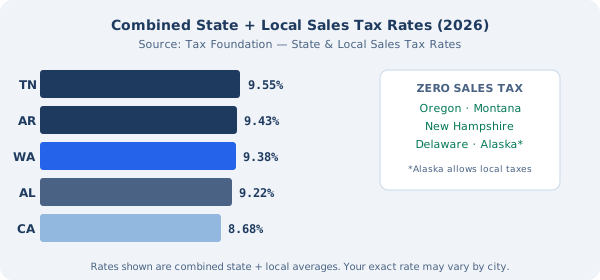
There are five of them: Oregon, Montana, New Hampshire, Delaware, and Alaska. The first four have neither a statewide rate nor local sales taxes. Alaska is the odd one out: no state rate, but local jurisdictions can tack on up to 7.5%, which catches plenty of tourists off guard in places like Juneau and Wrangell. Montana is similar in spirit, allowing resort communities (Whitefish, Big Sky, West Yellowstone) to levy their own local sales taxes.
If you're shopping in or shipping to any of these states, you generally pay no sales tax, but it's worth checking Alaskan locality rules if that's your destination.
Highest Combined State + Local Rates in 2026
Based on Tax Foundation data, these states lead the pack on combined averages:
| State | State Rate | Avg. Local | Combined Avg. |
|---|---|---|---|
| Tennessee | 7.00% | 2.55% | 9.55% |
| Louisiana | 4.45% | 5.10% | 9.55% |
| Washington | 6.50% | 2.88% | 9.38% |
| Alabama | 4.00% | 5.22% | 9.22% |
| Arkansas | 6.50% | 2.93% | 9.43% |
Washington's base is 6.5%, but many Seattle-area cities push the combined rate above 10% (Lynnwood and parts of Seattle hit 10.6%). Businesses shipping to Washington need to verify the exact destination rate rather than using a state average.
Major State Rates at a Glance
The most common states people search for:
California: State rate 7.25%, but local additions are significant. Los Angeles County averages 10.25%. The statewide combined average is approximately 8.68%. California's rate structure is among the most complex in the country: 58 counties, hundreds of cities, and dozens of special districts all layering rates together.
Texas: State rate 6.25%. Cities and counties can add up to 2%, making the combined average around 8.20%. Major cities like Houston, Dallas, and Austin are typically at 8.25%.
New York: State rate 4%, with New York City at 4.5% local, making NYC's total 8.875%. Statewide average is approximately 8.53%.
Florida: State rate 6%, with county surtaxes ranging from 0.5% to 1.5%. Combined average is around 7.01%. Florida has no county above 8%.
Illinois: State rate 6.25% (some items like food and drugs are taxed at 1%). Chicago area rates are much higher than downstate. Shop in the Loop and you're paying 10.25%; drive two hours south to Springfield and it drops to around 8.5%. Combined state average is roughly 8.73%.
Ohio: State rate 5.75%, plus county rates of 0.75% to 2.25%. Combined average around 7.24%.
Pennsylvania: State rate 6%, Philadelphia and Allegheny County add 2% and 1% respectively. Most of the state sits at 6%.
How Local Rates Work
Every state that allows local sales tax has its own rules about who can levy them. Generally:
- Counties can add a surcharge (often called a county option tax)
- Cities/municipalities can add their own rate on top
- Special districts (transit districts, stadium districts, public safety districts, and the like) can add additional small percentages
The result is that California has over 500 different sales tax rates in effect simultaneously. So "California's sales tax rate is 7.25%" is correct at the state level but misleading in practice. Most Californians pay more, and a handful pay much more.
Rate variance can also be surprisingly tight geographically. A single ZIP code in Chicago can span multiple taxing jurisdictions, so two addresses on the same block sometimes get different rates. Address-level lookups, not ZIP-level, are the reliable way to verify.
For the exact rate at a specific address, use your state's Department of Revenue rate lookup tool (search "[state name] sales tax rate lookup") or the IRS Sales Tax Deduction Calculator on irs.gov.
Groceries, Clothing, and Sales Tax Holidays
Not everything is taxed the same. Groceries are a big one: Tennessee, Mississippi, and Alabama still tax food for home consumption (Alabama at a reduced state rate after the 2023 cut, but local taxes still apply), while most states either fully exempt groceries or tax them at a reduced rate. Prepared food is usually taxed regardless. Clothing gets special treatment in a few places too, with Pennsylvania, Minnesota, and New Jersey exempting most apparel year-round.
A growing number of states also run sales tax holidays: short windows, typically a weekend, when specific items are exempt. The classic example is the back-to-school holiday in states like Texas, Florida, Tennessee, Virginia, and the Carolinas, where clothing and school supplies below a price cap are tax-free for two or three days in early August. A few states also run Energy Star appliance holidays and hurricane-preparedness holidays. The exact dates and qualifying items change every year, so check your state's Department of Revenue before you plan a purchase around one.
What Drives Rate Changes
Sales tax rates change more often than people expect. Common triggers:
- State budget shortfalls often lead to temporary rate increases that become permanent
- Voter-approved ballot measures for specific purposes (schools, transit, public safety)
- Sunsets of temporary tax reductions
- Local government decisions to fund capital projects
The Tax Foundation updates their rate tables annually, usually in January to reflect rate changes effective the new year. Our reverse tax calculator uses these updated averages for the preset state buttons.
How to Find Your Exact Rate
For a current transaction or receipt: The rate is printed on your receipt. Use that number, not a state average.
For planning purposes: Go to your state's Department of Revenue website and use their address-based lookup. Every state that has a sales tax has this tool. Examples:
- California: California Department of Tax and Fee Administration (CDTFA) at cdtfa.ca.gov
- Texas: Texas Comptroller at comptroller.texas.gov
- New York: New York Department of Taxation and Finance at tax.ny.gov
For quick estimates: Use the state preset buttons in our sales tax reverse calculator. The presets use Tax Foundation combined averages and are accurate enough for estimates and bookkeeping in most situations.
Sales Tax on Online Purchases
Since the South Dakota v. Wayfair Supreme Court ruling in 2018, online retailers must collect sales tax in states where they exceed economic nexus thresholds (typically $100,000 in sales or 200 transactions per year).
This means you now pay sales tax on most online purchases, collected at your destination's rate (where you live, not where the seller is). Some states exempt digital goods, software downloads, or streaming services, and the treatment varies considerably from one state to the next.
See our guide to sales tax on online purchases for a state-by-state breakdown of e-commerce tax rules.
Using These Rates with Our Calculator
When you're working backwards from a total (say, a reimbursement where you need to separate the pre-tax expense) use the exact rate from your receipt if you have it. If you don't, use the state average as an approximation and note it in your records.
Our reverse tax calculator includes presets for the six most commonly searched states (CA, TX, NY, FL, WA, IL). For any other state or a custom local rate, type the rate directly into the tax rate field.
For a detailed explanation of the formula, see our guide to calculating sales tax backwards.